

Advanced Deep Learning
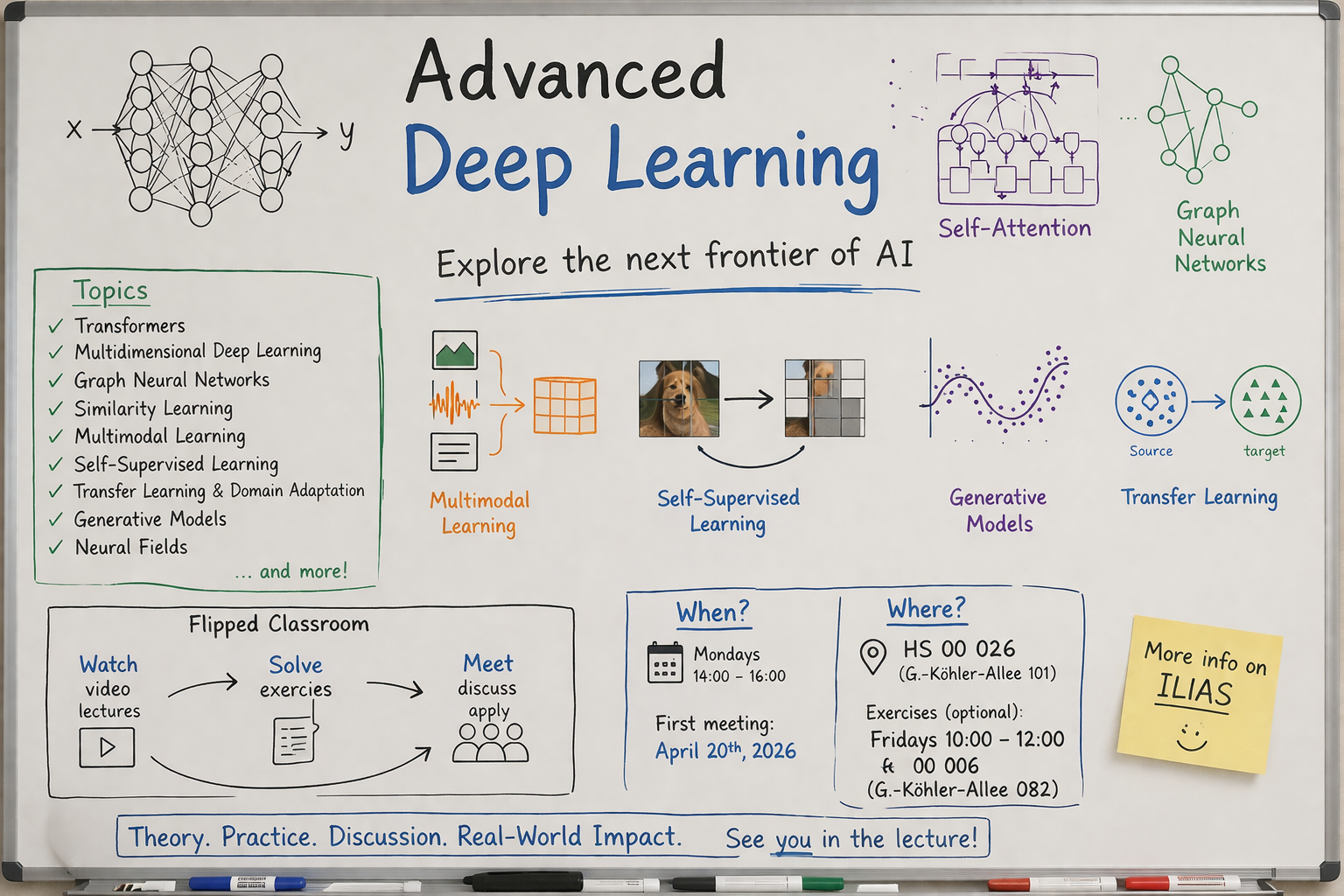
Deep learning techniques are constantly evolving and are nowadays recognized as the state-of-the-art solution in many problems in various domains. This course provides you with a good theoretical understanding and practical experience about advanced deep learning techniques and modern architectures include topics in Graph Neural Networks, Multi-dimensional Deep Learning, Transformers, Similarity Learning, Multi-modal Learning, Transfer Learning, Domain Adaptation, Self-supervised Learning, and Generative models. Furthermore, you should be able to use Deep Learning software libraries (PyTorch) in order to work on real-world applications of the content taught.
Details
| Time: |
Monday, 14:00-16:00 First meeting on April 20th 2026. |
|
| Location: |
|
|
|
Learning Platform: |
ILIAS | |
| Prerequisites: | Students must have completed a graded course equivalent to Foundations of Deep Learning |
Course Overview
The course will be taught in English and will follow a flipped classroom approach.
Every week there will be:
- a video lecture
- an exercise sheet
- a flipped classroom session (Monday, 14:00-16:00)
- an in-person exercise session (Fridays 10:00 - 12:00)
At the end, there will be a written exam.
Course Schedule
The following are the dates for the in-person lectures:
- 20.04.26 - Lecture 1: Introduction
- 27.04.26 - Lecture 2: Transformers I
- 04.05.26 - Lecture 3: Transformers II
- 11.05.26 - Lecture 4: Multidimensional Deep Learning
- 18.05.26 - Lecture 5: Graph Neural Networks
- 01.06.26 - Lecture 6: Similarity Learning
- 08.06.26 - Lecture 7: Multimodal Deep Learning
- 15.06.26 - Lecture 8: Self-Supervised Learning and Foundation Models
- 22.06.26 - Lecture 9: Transfer Learning, Domain Adaptation, and Continual Learning
- 29.06.26 - Lecture 10: Generative Models
- 06.07.26 - Lecture 11: Guest Lecture - From Research Papers to a Driving Car: Building a Deployable End-to-End ADAS Stack
- 13.07.26 - Lecture 12: Neural Scene Representations and World Models
- 20.07.26 - Lecture 13: Round-up / Exam Q&A
Questions?
If you have a question, please post it in the ILIAS forum (so everyone can benefit from the answer). Alternatively, you can also email adl-orga@cs.uni-freiburg.de